




|
消化系统 |
是/否 |
|
神经系统 |
是/否 |
|
呼吸系统 |
是/否 |
1
0
9
................................................................................................................................... ...........
................................................................................................................................... ...........
21
·为了阻止细菌进入病人的身体和传染给病人。
·为了防止细菌进入另一个要动手术的人的身体。
12
·为了杀死
11
·这样病人就不会被感染。
·为了防止疾病的传播。
代码01:其它回答。
·为了保持它们的干净。
·因为病人在动手术的时候容易被攻击。
99
A
B
C
D
1D
代码0:其它回答。
9
是/否 是/否 是/否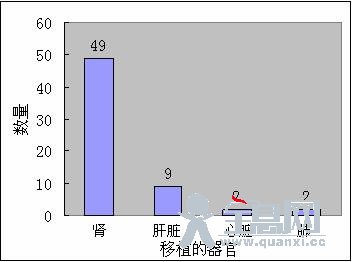
1
代码0:其它回答。
9
|
|
|
|
|
|
|
|
a |
|
1 |
2 |
3 |
4 |
|
b |
|
1 |
2 |
3 |
4 |
|
c |
|
1 |
2 |
3 |
4 |
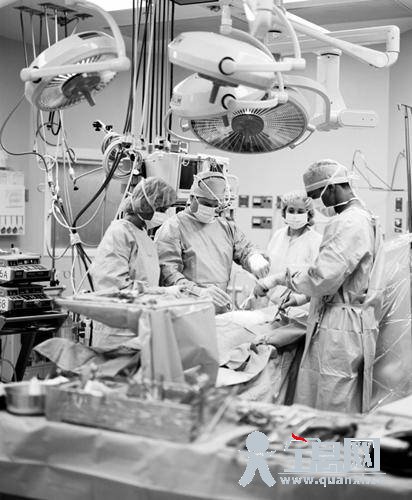
Major surgery, performed in specially equipped operating theatres, is necessary to treat many diseases.
While undergoing major surgery, patients are anaesthetised so they don’t feel any pain. The anaesthetic is often administered as a gas through a face mask that covers the nose and mouth.
Are the following human systems involved in the action of anaesthetic gases? Circle Yes” or “No” for each system.
Code 1: All three correct: No, Yes, Yes, in that order. Code 0: Other responses. Code 9: Missing.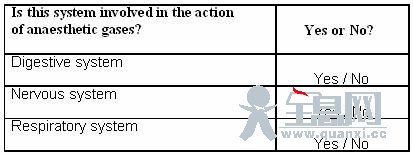
Explain why surgical instruments used in operating theatres are sterilized.
................................................................................................................................
..................................................................................................................................
Code 21: Student mentions both the need to ensure that there are no bacteria/germs on the instruments AND that this stops the spread of disease.
To stop bacteria getting in the body and infecting the patient.
So that no germs get into the body of another person going in for major surgery.
Code 12: Student mentions the need to ensure that there are no bacteria, BUT not that this stops the spread of disease.
To kill the germs on them.
Code 11: Student mentions that this stops the spread of disease, BUT not that it is because any bacteria on the instruments are killed.
So the patient is not infected.
To prevent any transfer of disease.
Code 01: Other responses
To keep them clean.
Because patients are vulnerable during surgery.
Code 99: Missing.
Patients may be unable to eat and drink after surgery and so they are put on a drip (infusion) that contains water, sugars and mineral salts. Sometimes antibiotics and tranquillisers are also added to the drip.
Why are the sugars that are added to the drip important for the post-operative patient?
A To avoid dehydration
B To control post-operative pain
C To cure post-operative infections
D To provide necessary nutrition
Code 1: D. To provide necessary nutrition
Code 0: Other responses.
Code 9: Missing.
Organ transplants involve major surgery and are becoming more and more common.In the graph below, the numbers of transplants carried out in a particular hospital during 2003 are given.
Code 1: All three correct: No, No, Yes in that order. Code 0: Other responses. Code 9: Missing.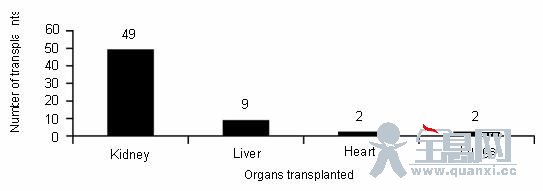
(责任编辑:王翔)
声明:文章版权归原作者所有,本文摘编仅作学习交流,非商业用途,所有文章都会注明来源,如有异议,请联系我们快速处理或删除,谢谢支持。
上一篇: PISA2006科学题目:进化
下一篇: PISA2006科学题目:白昼
-----主办-----
河南省乡村振兴协会
-----承办-----
河南省乡村振兴协会产业与信息化专业委员会
河南金农达供应链管理有限公司
河南全息农业科技有限公司
-----协办-----
全息数字科技